


You check the map pack for “electrician near me” and there’s a competitor with 40 reviews sitting above your business with 140. You’ve got more reviews, a better rating, and you’re still losing the click. This is the moment most owners start asking the wrong question, which is simply how many Google reviews to rank in the first place. The honest answer is that review count is one input among several, and treating it as the whole formula is why so many businesses in Kingsville, Ontario and the Windsor-Essex region plateau despite doing “everything right” on paper.
How Google Reviews Actually Influence Local Ranking
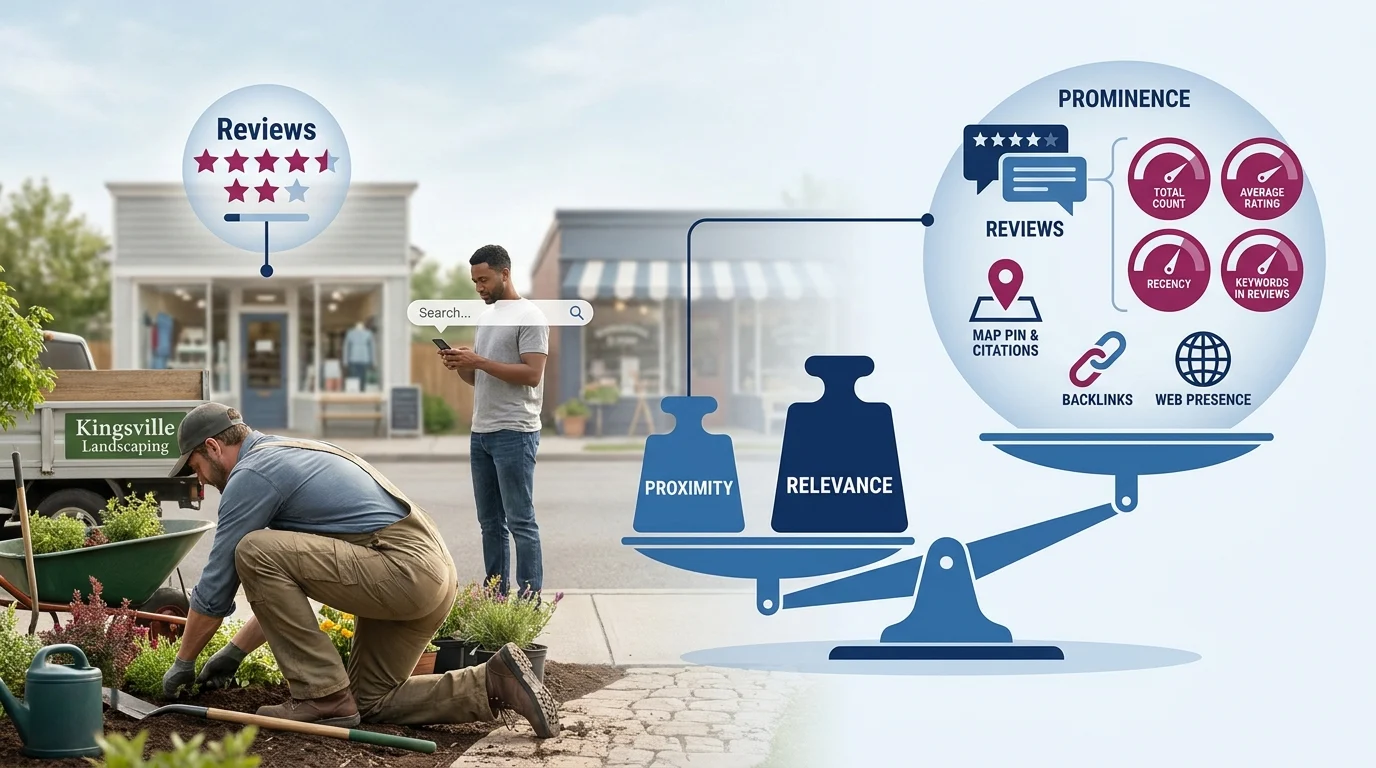
Google’s local algorithm weighs three core factors: proximity, relevance, and prominence. Reviews live inside prominence, alongside citations, backlinks, and overall web presence. They don’t override the other two.
Proximity and Relevance Still Lead
If a searcher is standing two kilometres from a competing shop, that competitor gets a structural advantage no review strategy fixes on its own. Relevance works the same way. A landscaper with “Kingsville landscaping” woven naturally into their profile and posts will out-rank a generalist with a thicker review stack but thinner keyword signal.
What Reviews Add to the Equation
Inside prominence, four things get measured: total count, average rating, how recently reviews arrived, and whether review text contains language that mirrors what people search. A tradesperson in Leamington whose reviews repeatedly mention “furnace repair” and “same day” is feeding Google exactly the relevance signal it’s hunting for, on top of the trust signal for the reader.
A Windsor-Essex Example
A Kingsville café with 60 reviews, three new in the last month, and consistent mentions of “patio” and “downtown Kingsville” can out-rank a Windsor competitor sitting on 300 reviews that stopped accumulating a year ago. Google reviews and ranking connect through momentum and specificity, not raw volume. That’s the mechanic worth building a strategy around before chasing a bigger number.
Quantity vs. Recency vs. Consistency: What Actually Moves the Needle
A stockpile of old five-star reviews reads as history to a searcher and as a stale signal to Google. The algorithm cares less about the size of that pile than about whether it’s still growing.
Why a Bigger Pile Doesn’t Move Rank
Total count matters up to a point, then flattens out. Once a business clears roughly the same range as its top three local competitors, adding more historical reviews stops producing gains. Google reviews and ranking correlate strongly at the low end, where zero reviews versus twenty is a real gap. Past that threshold, the correlation weakens fast.
Review Velocity Beats a Static Total
Review velocity, the pace at which new reviews land, tells Google the business is currently active, currently serving customers, and currently worth surfacing. A trickle of one or two fresh reviews a month outperforms a dormant profile sitting on triple the total. This is where local SEO reviews strategy actually lives: not in chasing a number, but in protecting a rhythm.
A Realistic Target for a Competitive Category
For most professional services and specialized trades in a competitive local category, the practical answer to how many Google reviews to rank sits between 30 and 50 total, with three to five new reviews landing every month, consistently, for six months or more. That pace signals sustained activity. It matters far more than crossing an arbitrary triple-digit count once and letting the profile go quiet.
Building a Realistic Review Target and Velocity System
A Simple Cadence Beats a Complicated Campaign
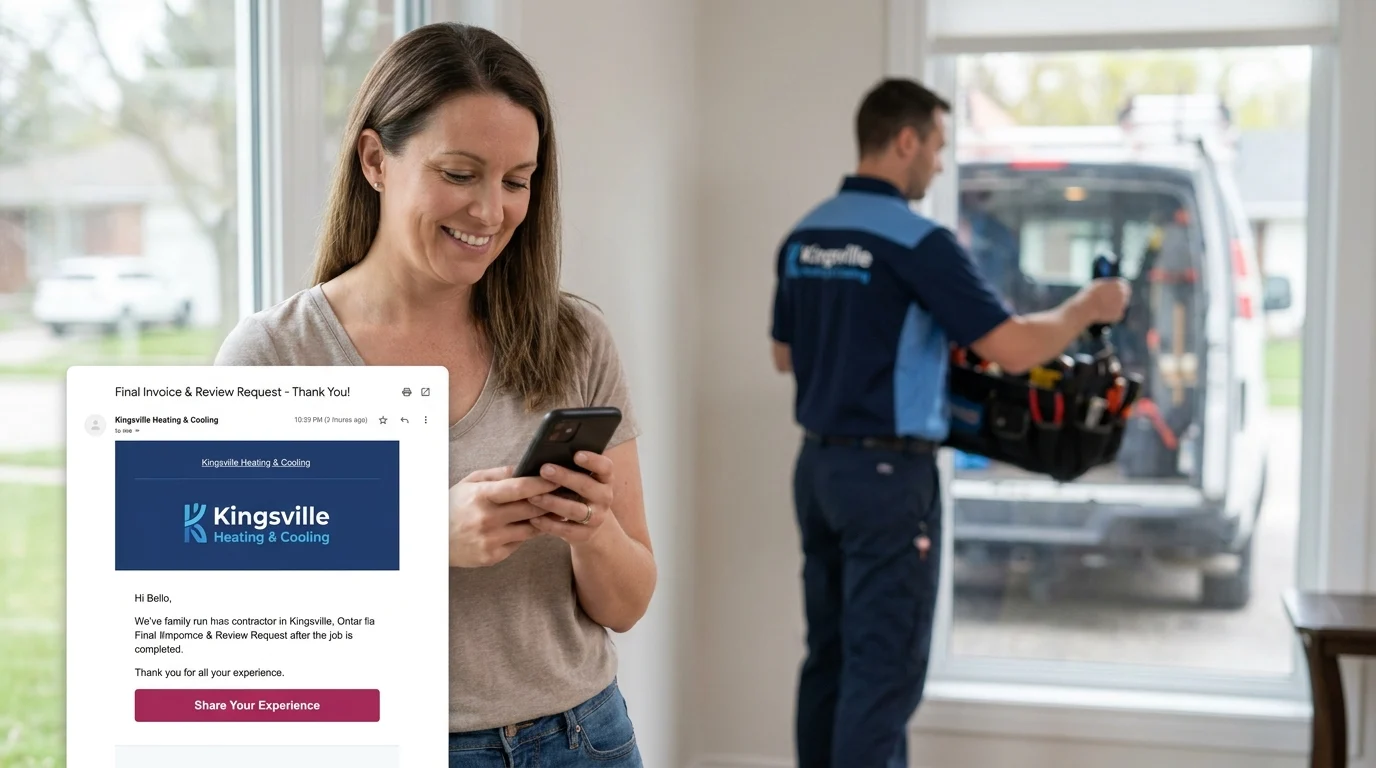
Pick the trigger point where a customer is happiest: invoice paid, job signed off, appointment finished. Ask there, every time, not weeks later when the memory has faded. A family-run HVAC contractor in Kingsville, Ontario built the request into its final invoice email and had a steady flow of new reviews within 90 days, without ever running a mass campaign or offering an incentive.
Build the Ask Into the Workflow, Not a One-Off Push
Velocity comes from a system, not a memory. A short link on the invoice, a text after the visit, a QR code at the counter. Automate the timing so the ask happens the same way every time, regardless of which staff member closed the job. That consistency is what protects local SEO reviews momentum once the initial push fades.
Follow Up Once, Then Let It Go
One polite nudge after a week if there’s no response. Repeated chasing reads as desperate and can cost more goodwill than the review is worth. This pattern works the same way for a plumbing outfit in Leamington as it does for a consulting practice in Kingsville, Ontario and the Windsor-Essex region: small, steady asks, built into the workflow, outperform an aggressive quarterly push aimed at hitting a number.
Key Takeaways

Chasing a bigger total won’t move a local ranking that’s already stalled. A profile that adds a handful of genuine reviews every month, tied to a system rather than a campaign, signals ongoing activity in a way a static pile of old five-star reviews never will. Set the ask at the moment a customer is satisfied, automate the timing, and follow up once. That rhythm, sustained for months rather than sprinted once, is what separates a business that ranks from one that used to.
Want this fitted rather than figured out? Doorways Into Your Business helps owner-operators put systems like this in place. Book a free consultation.
Paul Hughes founded Doorways Into Your Business after more than four decades consulting across 30+ countries, from implementing early IBM email systems in the 1980s to running multi-million-dollar IT projects for global organizations. A St. Clair College graduate (1976), he settled in Kingsville, Ontario in 2019 to help local small businesses grow with practical “smart digital doorways”, websites, customer service, reviews, bookings, and payments, matched to what a business actually needs, not unnecessary technology.
All articles by Paul →