


A homeowner in Kingsville, Ontario searching for emergency furnace repair doesn’t rely on marketing claims on a billboard. When pipes burst or roofs leak across the Windsor-Essex region, local buyers want immediate proof from neighbours who spent money with that contractor last week. Traditional marketing promises competence, but buyers treat self-serving claims with deep skepticism. Unfiltered feedback carries genuine weight because previous clients have 0 financial incentive to flatter a business owner. Understanding how public feedback shapes buyer confidence determines whether a prospective client dials your office or scrolls to the next competitor on the map.
Why Google Reviews for Small Business Drive the Decision to Call
Modern consumers evaluate service providers through a specific operational lens: risk reduction. When a prospective customer discovers a trade or professional service, they assume every claim on the company website represents an idealized sales pitch. Google reviews for small business cut through that skepticism by providing independent confirmation from real people who put their own money, time, and property on the line.
The Failure of Traditional Advertising Promises
Advertising informs the market that a company exists, but it rarely closes high-stakes service decisions. A print advertisement or radio spot can claim 24-hour emergency response, fair pricing, and clean workmanship. However, 88 percent of local buyers treat public feedback with the same weight as a direct personal recommendation from a colleague. When prospective clients read specific, unedited stories about a technician arriving on schedule or billing exactly as quoted, operational uncertainty disappears.
Risk Reduction at the Final Decision Point
Hiring a contractor, accountant, or auto repair shop carries direct financial risk. Local buyers look for operational patterns that protect them from bad outcomes. They examine specific details: Did the team clean up the job site? Was the estimate accurate? How did the company handle an unexpected delay? High star ratings attract initial attention on the map pack, but these concrete narratives supply the proof that justifies booking an appointment.
Local businesses that rely on self-promotional claims lose ground to competitors with steady streams of detailed customer feedback. When public records show consistent accountability and verified results, prospective clients move from casual evaluation to an immediate phone call.
Velocity, Volume, and Recency: What Builds Real Online Reviews Trust

A flawless 5.0 rating on a public profile often creates suspicion rather than confidence. Discerning buyers understand that service operations rarely run without occasional friction. When prospective clients evaluate Google reviews for small business credibility, they look past the aggregate star rating to analyze 3 distinct operational signals: recency, velocity, and volume.
Recency: The 90-Day Validity Window
Buyers evaluate current operational performance, not past achievements. Personnel changes, management shifts, and supplier substitutions alter service quality over time. A company with 150 high ratings whose latest entry dates back 6 months signals possible operational drift. Industry data indicates that 73 percent of consumers disregard feedback older than 90 days. Continuous, recent feedback proves that your service standards remain dependable this week.
Velocity: Consistent Cadence Over Sudden Spikes
Review velocity tracks the rhythm of incoming customer feedback over time. Sudden spikes, such as 25 submissions appearing in 3 days followed by months of silence, trigger spam filters on Google Business Profile and create doubt for cautious buyers. A steady pace of 2 to 5 genuine submissions every week demonstrates active job completion and an organized customer follow-up process.
Volume: Statistical Weight and Perspective
Total volume gives star ratings statistical validity. A 4.8-star average built on 160 detailed reviews carries vastly more authority than a pristine 5.0 rating supported by only 8 entries from personal acquaintances. High review counts also insulate your business against isolated negative experiences, ensuring a single anomalous complaint can’t disrupt your local search visibility or conversion rates.
When these 3 metrics align, your profile functions as an objective, real-time log of customer satisfaction. Buyers gain the confidence to proceed, knowing they’re hiring an active, proven team.
Building a Systematic Review Generation Engine into Daily Operations
Manual review requests fail because human memory is unreliable during a busy work week. When service technicians or office staff rely on memory, asking for feedback happens only when schedules allow. Generating consistent Google reviews for small business operations requires an automated workflow tied directly to clear operational milestones.
Pinpoint the Peak Satisfaction Moment
Timing determines your conversion rates. The ideal moment to ask for feedback is when the customer experiences immediate relief or satisfaction with the completed work. For a trade contractor, this occurs within 1 hour of the final walkthrough. For professional services, it aligns with delivering the final report or closing a project. Triggering an automated request within 2 to 4 hours of service delivery captures sentiment while the positive details remain vivid.
Eliminate Friction with Direct Links and SMS
Every additional step between the request and the review submission form reduces completion rates. A client should never have to search for your business name on a map. Generate your profile’s direct review shortcut link, which opens the 5-star rating and comment box immediately with a single tap.
Dispatch this link through SMS text message rather than email whenever mobile numbers are available. SMS open rates exceed 90 percent, and most text messages are read within 3 minutes. Structure the message around 3 simple elements:
- Mention the specific service completed or team member who assisted.
- Provide the direct short-link.
- Ask for honest feedback about their experience.
Integrate this trigger into your invoicing software or CRM system upon marking an invoice as paid or a job as complete. When the workflow runs automatically in the background, your review volume grows predictably without creating extra administrative work for your frontline staff.
Turning Criticism into Credibility on Your Google Business Profile
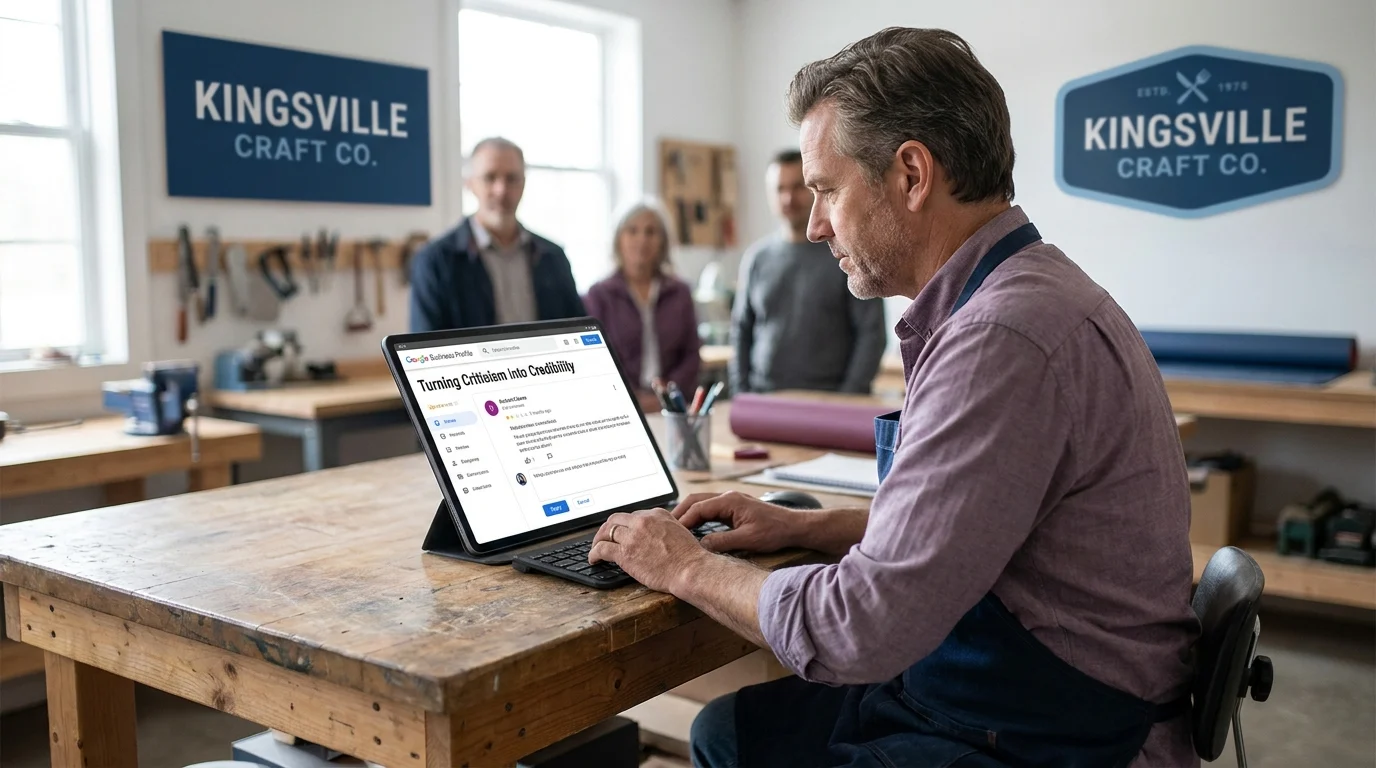
A flawless 5.0 rating often creates skepticism rather than confidence. High-intent prospects actively seek out negative feedback because they want to see what happens when an engagement encounters friction. When managing Google reviews for small business operations, a critical review presents a public opportunity to showcase operational maturity to every future buyer examining your listing.
The Audience for Your Response
Every response you post is written for the hundreds of silent prospects reading your profile over the next 12 months, not merely the individual who left the rating. Defensive replies and emotional counterarguments drive potential clients to your competitors. A disciplined response framework preserves trust and highlights your professional standards.
The 3-Step Professional Framework
- Acknowledge the experience promptly: Post a reply within 24 hours. Validate their frustration without debating disputed facts or assigning blame to staff members publicly.
- Take the resolution offline immediately: Supply a direct phone number and the name of a specific manager. Invite the reviewer to connect directly so you can resolve the issue.
- State your standard operating practice: Clarify the standard your team maintains on every project. This reassures prospective buyers that the reported breakdown is an anomaly rather than regular practice.
For example, if a homeowner notes a delayed service call, explain that punctual scheduling is your company’s baseline expectation, apologize for the communication lapse, and provide direct access to the operations lead. Readers recognize that field operations occasionally face unexpected delays. They look to your response to evaluate accountability, calm leadership, and your commitment to correcting mistakes.
Handled with precision, a low-star review often acts as the strongest proof of your business integrity.
Deploying Customer Reviews Across Every Smart Digital Doorway
Securing feedback on your profile is only half the battle. Google reviews for small business provide the greatest return when actively deployed across every touchpoint where prospects experience friction or hesitation. Isolating positive sentiment on a single directory leaves your other sales channels working twice as hard to establish trust.
High-Conversion Review Placements
Strategic review syndication targets the exact moments buyers hesitate before signing a contract or submitting an inquiry:
- Estimates and Proposals: Position verified feedback directly adjacent to your scope of work and pricing summaries. When a prospective client evaluates project costs, seeing recent praise for clean job sites or transparent billing immediately lowers perceived financial risk.
- Core Service Pages: Place verbatim client testimonials alongside specific service descriptions. A generic testimonial on a home page carries less weight than a targeted review detailing a furnace installation on the specific heating repair page.
- Quote Follow-Up Sequences: Incorporate brief client quotes into your email or SMS follow-ups. If a lead hasn’t signed an estimate after 3 days, a short follow-up note highlighting a similar successful project maintains momentum.
- Printed Collateral and Signage: Feature direct review excerpts on leave-behind folders, vehicle decals, and invoice footers to reinforce reputation across offline interactions.
Matching Proof to Specific Customer Objections
Effective syndication relies on contextual relevance rather than blanket ratings. Pair reviews that highlight speed of service on emergency call-out pages, and place feedback addressing meticulous craftsmanship alongside high-ticket custom work. When buyers see their exact doubts resolved by real customers, decision fatigue disappears and conversion rates rise.
Your Monday Morning Blueprint to Get More Google Reviews

Execution separates operators who consistently generate Google reviews for small business from those who rely on chance. You do not need complex software to start. You need a standard operating procedure your team can run every single week.
Step 1: Extract and Test Your Direct Review Link
Open your Google Business Profile dashboard and generate your short review link. Test the link on both desktop and mobile devices to verify that it lands directly on the star rating and comment box. Save this link in an accessible snippet manager or pinned document so field staff and office personnel can access it in 5 seconds or less.
Step 2: Define the Handoff Trigger
Identify the exact moment when customer satisfaction peaks. For service contractors, this happens when the work order is signed. For professional services, it happens upon final project delivery. Write a single SMS and email template asking for specific feedback on project quality, cleanliness, or communication. Tie the sending of this template directly to your invoice dispatch or job completion status in your management software.
Step 3: Assign Daily Ownership and Set Weekly Targets
Assign 1 team member to monitor inbound reviews and coordinate outgoing requests. Set a baseline goal: request feedback from 100 percent of completed jobs, aiming for a minimum of 2 to 3 new verified reviews each week. Review this metric during your weekly operational check-ins alongside revenue and pipeline numbers.
Step 4: Establish a 24-Hour Response Protocol
Draft response frameworks for 5-star, neutral, and critical feedback. Commit to replying to all public reviews within 24 business hours. Use each response to mention the specific service performed and your general service area, reinforcing your local authority on search engines.
Key Takeaways for Sustainable Reputation Growth
A high-performing review profile is an operational asset that compounds over time. Whether operating a trades company, retail outlet, or professional firm in Kingsville, Ontario and the Windsor-Essex region, consistency beats sporadic review campaigns every time. High review velocity, steady recency, and transparent owner responses signal operational excellence to both search algorithms and prospective customers.
Treat customer feedback as an integrated pillar of your customer fulfillment process rather than an afterthought. When you remove friction from the submission process and systematically syndicate verified proof across your sales materials, you build a durable advantage that competitors can’t easily duplicate.
Paul Hughes founded Doorways Into Your Business after more than four decades consulting across 30+ countries, from implementing early IBM email systems in the 1980s to running multi-million-dollar IT projects for global organizations. A St. Clair College graduate (1976), he settled in Kingsville, Ontario in 2019 to help local small businesses grow with practical “smart digital doorways”, websites, customer service, reviews, bookings, and payments, matched to what a business actually needs, not unnecessary technology.
All articles by Paul →