


A ringing phone on an active job site or an empty front desk carries an immediate price tag. For a service company in Kingsville, Ontario and the Windsor-Essex Region, an unanswered ring is rarely a customer who patiently waits to try again later. Instead, that caller taps the next search result on Google within 30 seconds. A missed call small business owners overlook during a busy lunch hour or while driving between appointments transfers hard-earned marketing dollars directly to a competitor down the street. Understanding the true financial impact requires looking past the immediate transaction to calculate what that single dropped conversation costs your business over years.
Calculating the Real Revenue Cost of Every Missed Call Small Business Owners Face
Most business owners evaluate an unanswered phone call by the value of a single service visit. If a contractor averages $450 per service call, missing 4 calls a week appears to be an $1,800 weekly nuisance. That math ignores how local commerce actually functions.
The True Mathematics of Lifetime Value
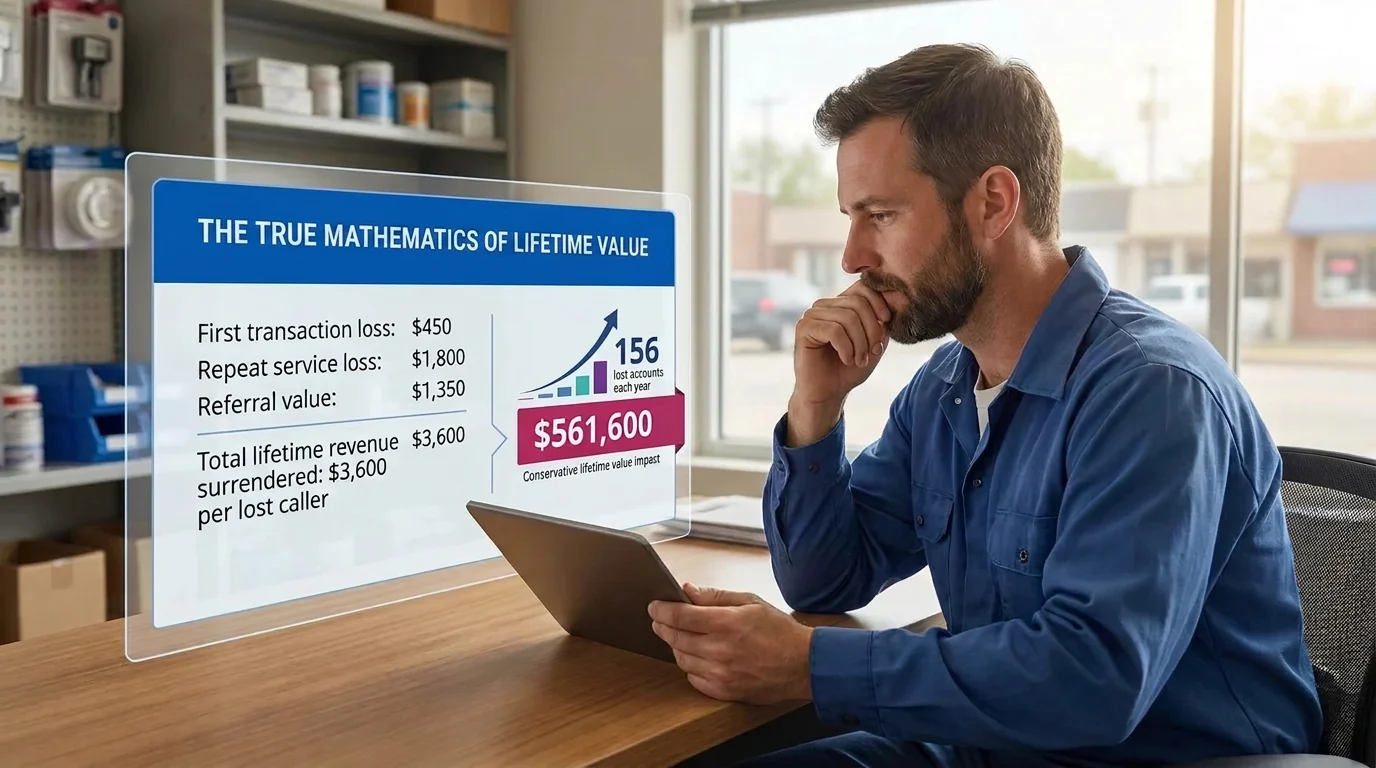
The initial ticket is only the baseline. When an unanswered inquiry routes to another local company, you surrender the lifetime value of that customer. A homeowner who books an emergency electrical repair today often needs a panel upgrade next spring and regular maintenance for the next 7 years.
- First transaction loss: $450 in immediate gross revenue
- Repeat service loss: $1,800 over 4 subsequent service appointments
- Referral value: $1,350 from 3 neighbours or family recommendations
- Total lifetime revenue surrendered: $3,600 per lost caller
Missing just 3 viable new customer calls a week compounds to 156 lost accounts each year. At a conservative lifetime value of $3,600, your operation leaks $561,600 in long-term enterprise value annually.
Wasted Customer Acquisition Spend
Beyond lost sales, an unanswered phone burns your existing marketing budget. Whether you spend capital on local search optimization, vehicle wraps, or digital ads, you pay a concrete cost per lead. If your average cost to generate a phone inquiry is $45, every unanswered ring represents marketing spend that converts directly into zero revenue. You absorb the complete cost of generating the lead, while the competitor who picks up the phone secures the revenue without spending a single dollar to generate the inquiry.
The Death of Voicemail: Why Modern Prospects Won’t Wait for a Callback
Voicemail was designed for an era when communication moved at a deliberate pace. For a modern consumer with an immediate problem, encountering a generic voicemail greeting feels like hitting a dead end. Industry data consistently shows that over 75 percent of callers hang up the moment an automated recording starts, treating an unanswered ring as a definitive refusal of service.
The Zero-Friction Alternative on the Results Page
When a prospect searches for a local contractor or professional service, they evaluate 3 to 5 options side by side on a mobile device. The effort required to bypass an unresponsive business is non-existent. Tapping the next listing on Google takes under 2 seconds.
Leaving a voice message demands unreciprocated effort from the buyer. The caller must sit through a recorded greeting, articulate their project requirements, leave their contact information, and wait indefinitely for a callback. Dialling the next competitor carries none of that uncertainty. Buyers want immediate certainty, and they continue down the search results until a live person answers the line or confirms an appointment.
The Trust Penalty of an Unanswered Ring
A missed call small business owners overlook sends an immediate signal about operational capacity. When an inquiry goes unanswered during standard operating hours, prospective clients draw rapid conclusions about reliability. If reaching the company to book initial work requires leaving messages and waiting hours for a response, the customer assumes the actual project execution will suffer from identical communication bottlenecks.
Speed is the primary differentiator during initial outreach. High-intent buyers are focused on checking a task off their daily list. Leaving prospects in voicemail limbo transfers high-value inquiries directly into the revenue pipeline of the first competitor who answers promptly.
Diagnosing the Operational Blind Spots: Job Sites, Transit, and After Hours Calls
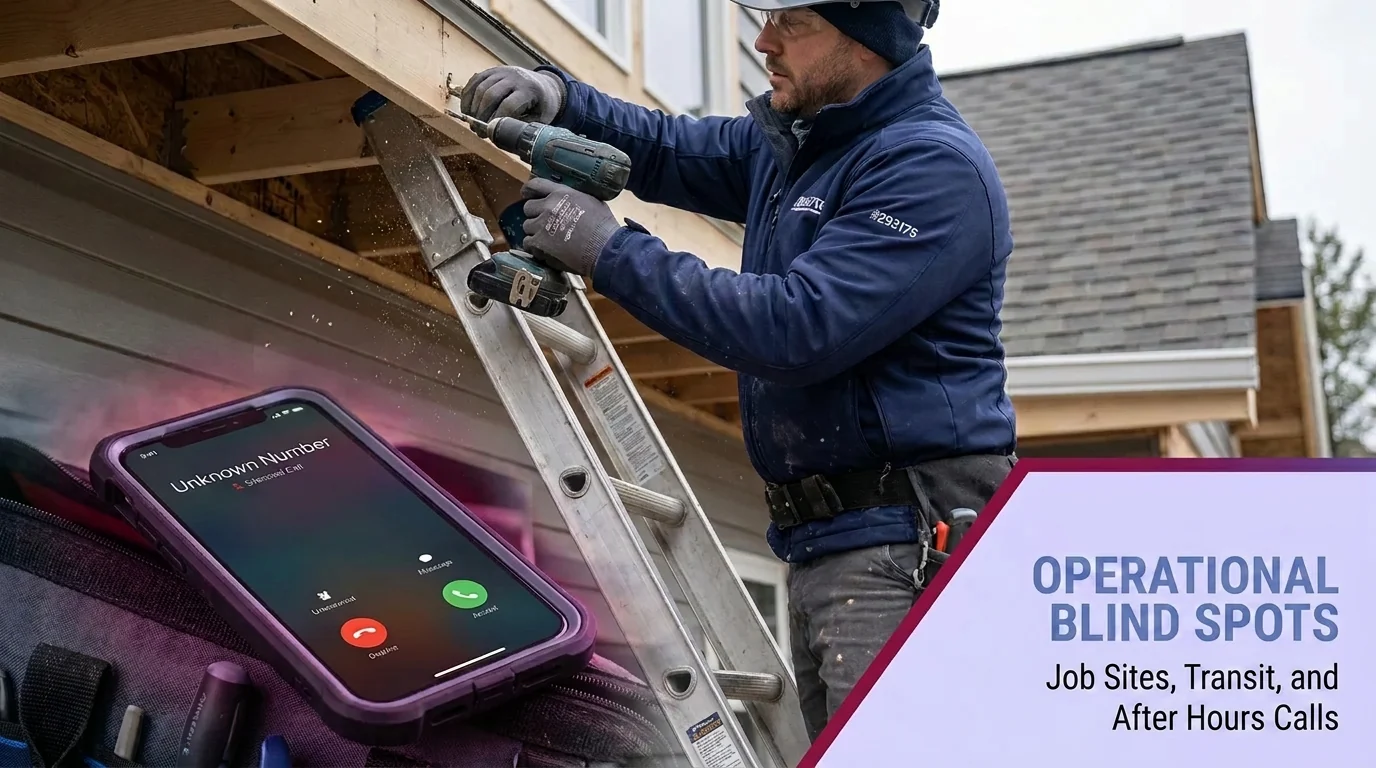
Most unanswered inquiries don’t happen because a company is neglectful. They happen because core operations physically pull staff away from the phone. For trades and field service operators across the Windsor-Essex Region, incoming inquiries peak at the exact hours when technicians are least able to answer them.
Active Field Work and Safety Constraints
When a technician is on a ladder, operating machinery, or troubleshooting equipment, answering a ringing phone is impossible and unsafe. Ambient job site noise frequently drowns out ringtones entirely. Every time an installer silences a call to maintain safety on a job site, a prospective client is left waiting on the line. Small teams without dedicated office staff regularly drop 3 to 6 high-value inbound inquiries every day simply by performing the physical work they were hired to do.
Transit and Driving Bottlenecks
Service professionals spend hours each week driving between project locations. While hands-free devices permit voice conversations, a driver can’t safely check dispatch software, confirm calendar availability, or record property addresses while in traffic. Asking a prospective customer to wait while navigating a busy intersection creates friction. Operators frequently let calls roll to voicemail while driving, intending to return them once parked, by which point the lead has contacted another provider.
The Evening Inbound Window
Consumer search behaviour doesn’t align with standard 8 AM to 5 PM office schedules. Homeowners frequently research renovations, repairs, or professional services between 6 PM and 9 PM after their own workday ends. When a company shuts down phone coverage at 5 PM sharp, every evening inquiry becomes a missed call small business operators only discover the next morning. By 8:30 AM, those prospects have already secured service elsewhere.
Instant Engagement: Using Missed Call Text Back to Halt the Competitor Search
When a prospective customer calls a local service provider and gets no answer, their default reflex isn’t to leave a voicemail. They tap the back button on their mobile screen and call the next listing in Google. To stop that search loop, you must intercept the prospect before they place that second call.
The Mechanics of Automated SMS Interception
A missed call text back system monitors inbound telephony lines. The moment a call disconnects without an answer or drops into voicemail, the software triggers an automated SMS to the caller’s mobile number within 5 to 10 seconds. This message acknowledges the outreach instantly and opens a direct two-way text channel.
An effective initial message keeps friction low and sets clear operational expectations:
- “Hi, thanks for calling [Company Name]. We’re currently assisting a client on-site. How can we help you today?”
- “Sorry we missed your call. We’re on a service call right now. Reply here with the details of your project, and our team will get back to you shortly.”
Securing the Lead Before Competitors Respond
Receiving an immediate text message fundamentally changes caller behaviour. The prospect pauses their active search because they’ve received confirmation that their request is being handled. Rather than dialling 3 more contractors down the list, they reply with photos of their repair issue, a brief description of the job, or their property address.
For every missed call small business operators experience during busy working hours, automated text back converts what would have been lost revenue into an active sales thread. Technicians and dispatchers can review and answer text messages between tasks without interrupting hands-on work.
Engineering a Smart Digital Doorway to Never Miss a Lead
A single automated text message stops a prospect from hiring a competitor, but full pipeline protection requires an integrated workflow. Treating telephony as an isolated channel creates operational friction. To handle call volume without swelling administrative payroll, trade contractors and service firms build digital doorways that unite phone routing, instant intake, and pipeline tracking into a single responsive system.
Intelligent Routing and Escalation
Modern call infrastructure directs incoming inquiries based on live operational availability rather than letting a landline ring endlessly. A reliable routing framework operates across 3 synchronized levels:
- Simultaneous Ring: Inbound calls dial primary dispatchers and available mobile managers at the same time, maximizing live response rates during peak hours.
- Conditional Fallback: If no staff member picks up within 15 seconds, the system logs the contact record and immediately launches the text-based engagement protocol.
- After-Hours Triaging: Evening and weekend calls bypass silent mailboxes entirely, redirecting callers to an interactive digital intake queue.
Automated Qualification and Pipeline Sync
Capturing the phone number is only half the battle. The digital doorway must qualify the prospect before a team member steps in. Following the initial SMS, automated conversational prompts collect essential job specifications: project category, service address, and timing requirements.
This intake data feeds directly into central scheduling and customer management software. When reviewing a missed call small business operators don’t scramble to decipher vague voice recordings. They review an organized, pre-qualified job profile, ready for immediate dispatch or formal quoting.
This structure standardizes service delivery across the entire organization. High-value emergencies are flagged instantly for on-call personnel, while routine maintenance inquiries populate the regular booking calendar automatically, converting raw phone traffic into structured revenue opportunities.
The Monday Morning Action Plan: Concrete Steps to Capture Missed Calls
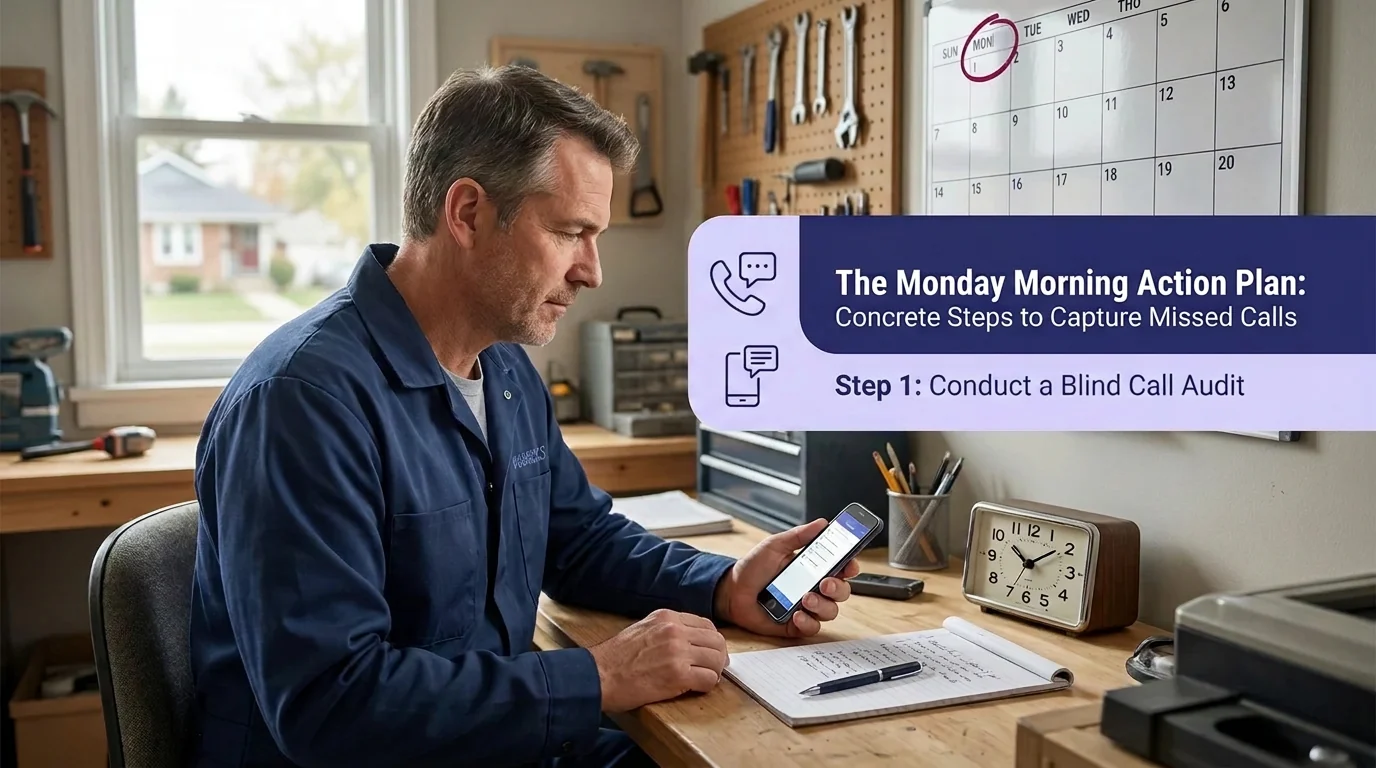
Transforming call capture from a chronic operational vulnerability into a dependable revenue channel requires immediate, structured execution. Local service providers can’t afford weeks of theoretical planning while incoming inquiries slip away. Follow this 4-step implementation sequence to audit existing infrastructure and deploy a reliable response protocol starting Monday morning.
Step 1: Conduct a Blind Call Audit
Test your primary business line under actual operating conditions. Place test calls from an external mobile device during 3 distinct operational windows: peak lunch hour (12:15 PM), late transit hours (5:15 PM), and weekend off-hours (Saturday at 10:00 AM). Document the exact outcome: the number of rings before pickup, voicemail clarity, and the presence or absence of follow-up messaging. This baseline audit exposes operational leaks instantly.
Step 2: Configure Instant Text-Back Triggers
Set up automated SMS triggers tied directly to unanswered inbound calls. When managing a missed call small business operators must ensure the response fires within 90 seconds. Draft a clear message acknowledging the incoming inquiry, specifying your team’s operational status, and prompting the prospect to reply with their specific project details, service location, or preferred consultation window.
Step 3: Establish Dispatch Assignment Rules
Define clear operational ownership for every inbound digital lead. Assign designated team members to monitor the central response queue during regular business hours. Connect intake forms directly to your operational dispatch software so technician calendars update without manual data re-entry, administrative bottlenecks, or scheduling friction.
Step 4: Monitor Inbound Recovery Metrics
Review weekly call volume alongside digital response rates every Monday. Track how many uncompleted calls generated active SMS dialogues, how many prospects completed digital intake forms, and how many converted into paid estimates. Adjust messaging parameters to eliminate drop-off points continuously.
Key Takeaways for Long-Term Lead Retention
An unanswered business line transfers hard-earned marketing investment directly to your fastest-responding competitor. Modern consumers demand immediate confirmation, and unattended voicemail boxes guarantee abandoned inquiries. Implementing automated text back, simultaneous team routing, and structured digital intake forms secures your operational pipeline against common blind spots while crews focus on active job sites.
For service companies throughout Kingsville, Ontario and the Windsor-Essex Region, closing the response gap protects local market share and increases operational margins. Every incoming call represents acquisition budget already spent; building responsive digital capture channels ensures that investment converts into reliable, compounding company revenue.
Paul Hughes founded Doorways Into Your Business after more than five decades consulting across 30+ countries, from implementing early IBM email systems in the 1980s to running multi-million-dollar IT projects for global organizations. A St. Clair College graduate (1976), he settled in Kingsville, Ontario in 2019 to help local small businesses grow with practical “smart digital doorways”, websites, customer service, reviews, bookings, and payments, matched to what a business needs, not unnecessary technology.
All articles by Paul →