

Small business owners spend hours every week answering the exact same set of customer inquiries. Questions regarding operational hours, service pricing, service boundaries, and booking steps flood email inboxes, text channels, and phone systems daily. When managing operations in Kingsville, Ontario and the Windsor-Essex region, every minute spent manually retyping directions or repeating basic qualification criteria is time lost from revenue-generating work. Most customer inquiries follow a predictable pattern where roughly 80 percent of incoming volume revolves around fewer than ten recurring topics. Establishing an efficient response workflow starts by auditing these routine interactions before they drain your daily administrative capacity.
Audit Your Repetitive Inquiries: How to Identify the 80% You Can Automate
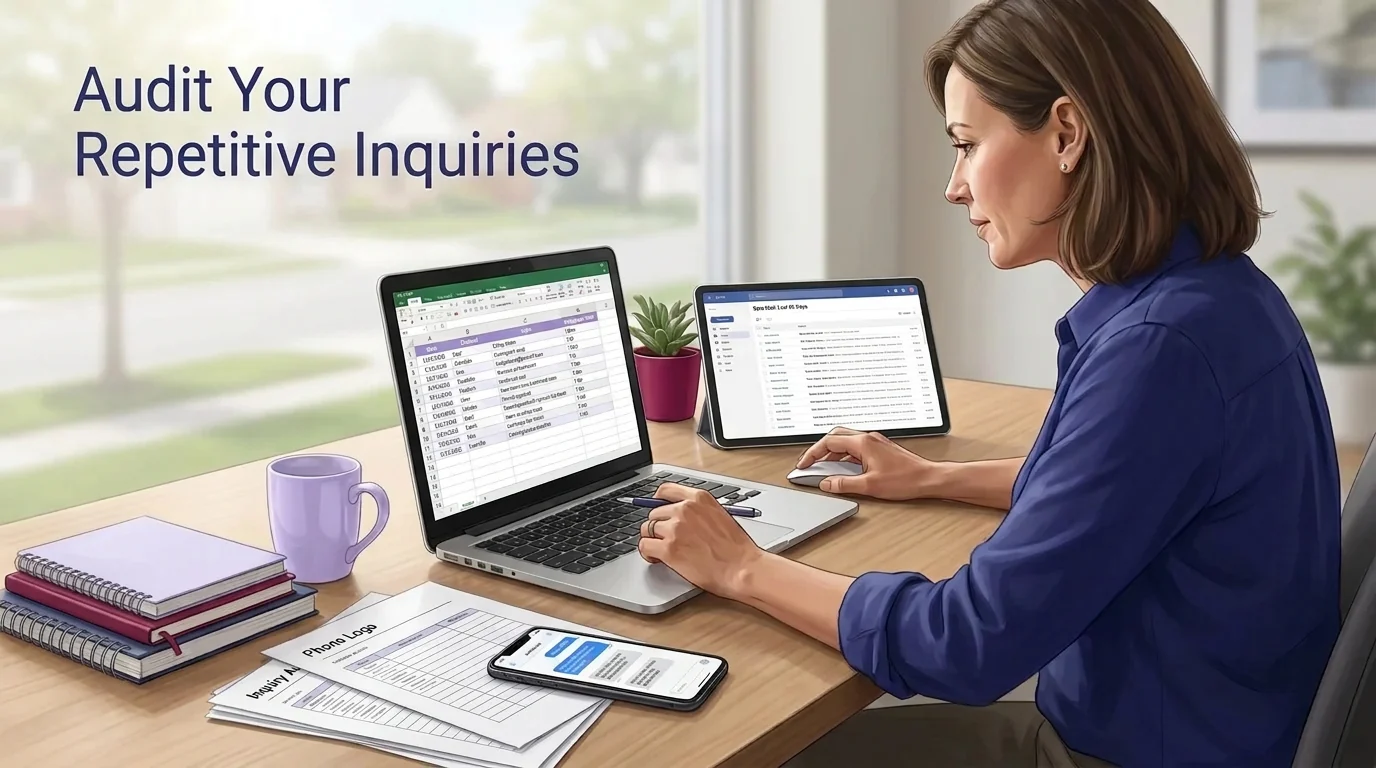
Before deploying automated systems, you need an accurate inventory of what prospective and existing clients actually ask. Guessing leads to automated tools that address the wrong topics while leaving major friction points unaddressed. A structured audit grounds your implementation in real operational data, ensuring you target high-volume requests first.
Mine Your Active Communication Channels
Review the last 30 to 60 days of customer interactions across all primary intake channels. Examine sent email folders, text messaging platforms, and phone logs. Track these inquiries in a temporary spreadsheet with columns for the interaction date, channel, topic category, and estimated response time. Look for heavy repetition in simple requests such as payment options, turnaround times, and intake steps. A service business operating in the Windsor-Essex area might discover that nearly 30 percent of incoming messages simply request geographic service confirmations or address details.
Categorize and Prepare Standard Responses
Once you log 100 to 150 inquiries, group them by primary subject matter. Clear clusters will emerge around specific operational items. Separate custom, high-touch inquiries that require manual evaluation from standard informational questions. These high-frequency, low-complexity queries form your primary automation dataset. Write down clear, direct canonical answers for each question topic. This vetted repository of answers becomes the core foundation used to automate customer questions small business operations handle on a daily basis.
Quantify the Potential Time Savings
Multiply the average time required to address each routine question by its weekly volume. If answering basic pricing questions takes four minutes and happens 25 times per week, that single topic costs nearly two hours of manual labour weekly. Pinpointing these exact operational bottlenecks allows you to prioritize which responses to digitize first for maximum operational impact.
Deploy an Automated Answer Layer to Automate Customer Questions for Small Business
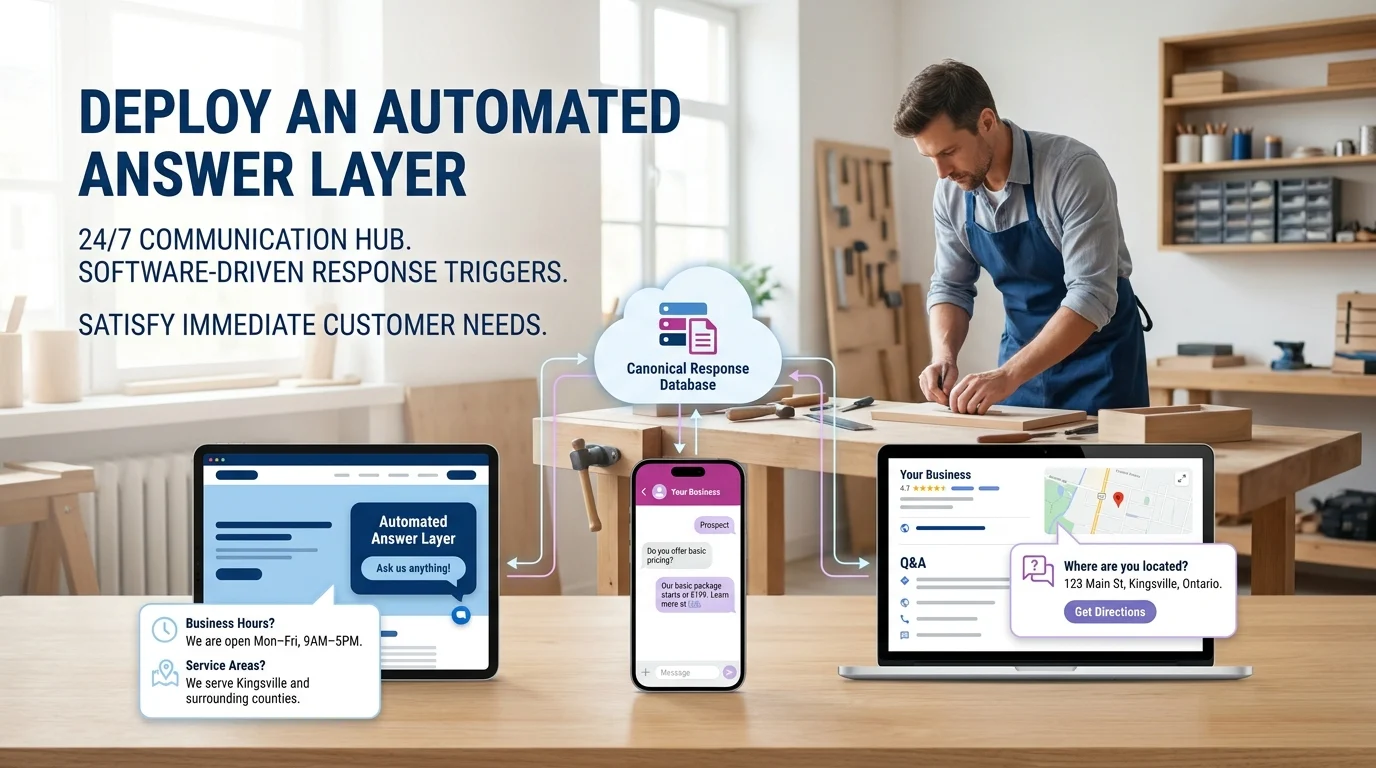
Once you build your canonical response database, the next step is publishing those answers through automated, customer-facing touchpoints. Implementing an automated answer layer means placing software-driven response triggers across your website, Google Business Profile, and text channels. When a prospect asks about business hours, service areas, or basic pricing, the system instantly delivers the pre-approved answer. This infrastructure turns a static website into an active, 24/7 communication hub that satisfies immediate customer needs while keeping your staff focused on higher-value tasks.
Configure Interactive Web Widgets and Instant SMS
Modern web chat and messaging tools don’t require complex custom coding to execute effectively. Install lightweight chat interfaces directly on your primary landing pages and program them with decision trees based on your top FAQ categories. Simultaneously, configure missed-call text-back and instant SMS workflows. If a customer calls after hours, an automated text message can immediately offer to answer their question via text menu or web link. For a home services business in Kingsville, Ontario and the Windsor-Essex region, this instant response captures leads before they reach out to a competitor down the road.
Sync Messaging Workflows with Live Operational Data
An automated answer layer works best when integrated into your backend operational software. Connect your chat interface to your scheduling calendar, CRM, and order processing database using native platform integrations or webhook triggers. When a customer asks about open service slots or appointment details, the automated workflow queries your real-time operational data and provides an exact answer in seconds.
Connecting these integrated communication pathways allows you to automate customer questions small business teams traditionally waste hours answering manually. This setup handles routine inquiries around the clock without sacrificing accuracy or response quality.
Design the Escalation Protocol: Where Human Expertise Still Matters

Automating initial touchpoints frees up hours of administrative work, but technology should never insulate your company from high-value opportunities. An automated system handles standard information requests specifically so your personnel can focus on complex proposals, custom jobs, and sensitive customer concerns. Establishing precise escalation boundaries ensures routine queries resolve automatically while high-value prospects receive immediate personal attention.
Paul Hughes founded Doorways Into Your Business after more than four decades consulting across 30+ countries, from implementing early IBM email systems in the 1980s to running multi-million-dollar IT projects for global organizations. A St. Clair College graduate (1976), he settled in Kingsville, Ontario in 2019 to help local small businesses grow with practical “smart digital doorways”, websites, customer service, reviews, bookings, and payments, matched to what a business actually needs, not unnecessary technology.
All articles by Paul →