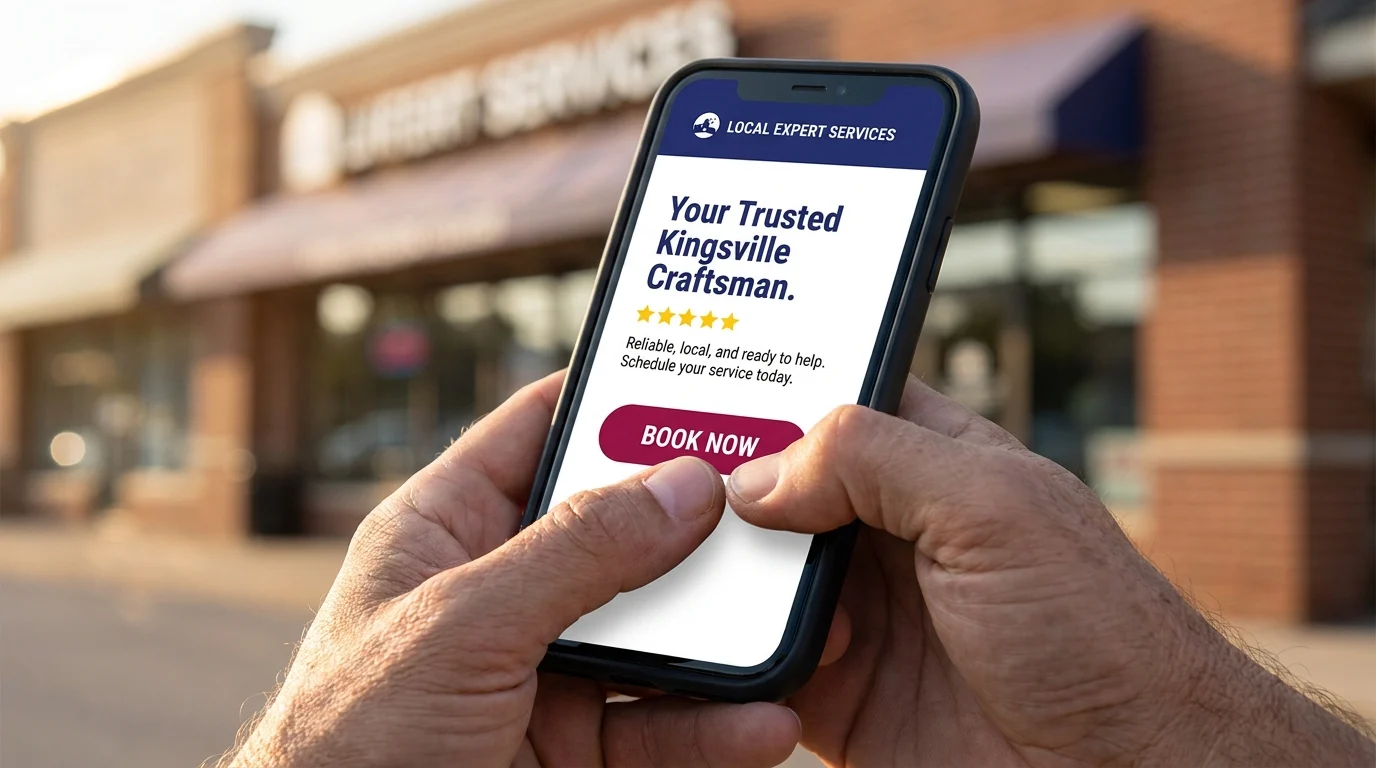


Most small business owners hear “text message marketing” and picture either a goldmine of instant sales or a fast track to annoying their customers into unsubscribing. The truth sits in between, and it depends almost entirely on how you run it. SMS is one of the few channels where customers genuinely read what you send within minutes, but it carries real costs and a compliance layer that email never demanded. Before you spend a dollar on it, you need to know what the numbers actually say.
For owners in Kingsville, Ontario and the Windsor-Essex Region weighing where to put a limited marketing budget in 2026, this is the question worth answering with data rather than gut feel. Here is how SMS marketing for small business stacks up on cost, what compliance now requires, and how it compares to the email channel you are probably already using.
The Real Numbers: Costs, Compliance, and How SMS Stacks Up Against Email

What SMS actually costs
SMS pricing is usage-based, not flat-rate like most email tools. In Canada and the US, you can expect to pay roughly 1 to 3 cents per message segment sent, plus a monthly platform fee that often runs $20 to $50 for small-volume plans. A segment is 160 characters, so a longer message counts as two sends and doubles the per-message cost.
Run the math on a list of 500 subscribers receiving two messages a month: about 1,000 sends, or $10 to $30 in message fees on top of your platform cost. That is cheap if those texts drive bookings or sales, and wasteful if they do not. The cost discipline forces you to send only when you have something worth saying, which is part of why SMS tends to perform.
Compliance is not optional
The biggest change for small businesses sending texts is A2P 10DLC registration. Application-to-Person messaging over standard 10-digit long codes now requires you to register your business and your campaign with the carriers, usually through your SMS platform. Unregistered traffic gets filtered or blocked, so skipping this step means your messages quietly fail to deliver.
SMS opt-in compliance is equally firm. You need explicit consent before texting anyone, a clear description of what they are signing up for, and a working opt-out (replying STOP). In Canada, CASL governs commercial messages and the penalties for ignoring it are steep. Document how every subscriber opted in and keep that record.
SMS vs email: the open-rate gap
In the SMS vs email comparison, the numbers are stark. Email open rates for small businesses typically land between 20 and 30 percent, and click rates in the low single digits. SMS open rates routinely sit above 90 percent, with most messages read within three minutes of delivery. Response rates on SMS regularly hit 15 to 20 percent against email’s 2 to 5 percent.
That does not make email obsolete. Email is free to scale, carries detailed content, and remains the workhorse for newsletters and long-form offers. SMS wins for anything time-sensitive: appointment reminders, flash promotions, restock alerts, and back-in-stock notices. The smart play for most Windsor-Essex businesses is using both, with SMS reserved for messages that genuinely need to be read now.
What Actually Works (and What Kills Your Opt-Ins)
The difference between SMS marketing for small business that grows your list and SMS that empties it comes down to one question: does the text help the customer, or just the business? Customers gave you their cell number for a reason. The messages that respect that reason perform. The ones that abuse it bleed opt-outs.
The Messages That Earn Their Place
Appointment reminders. This is the single highest-value text most service businesses can send. A dentist, salon, or auto shop in the Windsor-Essex Region that texts “See you tomorrow at 2pm. Reply C to confirm or R to reschedule” recovers no-show revenue immediately. Customers welcome it because it serves them, not you.
Time-sensitive offers. SMS is built for urgency. A flash sale ending tonight, a limited table count, a Saturday-only discount: these match the format. The 98 percent open rate means people actually see the offer while it still matters. A weekly “great deals” blast does not.
Back-in-stock and ready-for-pickup alerts. When a customer asked to be notified, the text is the payoff of a request they made. Retailers see strong conversion here because the interest already exists. The same logic applies to “your order is ready” and “your repair is done.”
Review requests. A short text sent a day after service, asking for a quick Google review with the link, drives review volume better than email. People check texts; they ignore review-request emails. Send one ask, not three.
What Drives People to Unsubscribe
Over-texting is the fastest way to lose a list. More than four to six messages a month, and unsubscribes climb sharply. Every text should feel like the exception, not the routine.
- Sending at bad hours. A 7am or 10pm promo reads as an intrusion. Keep marketing texts to business hours.
- Generic blasts with no relevance. A text that ignores what the customer bought or asked for trains them to opt out.
- No clear value. If the message does not save time, money, or a missed appointment, it should not be sent.
- Making opt-out hard. Hide the STOP option and you invite spam complaints, which carry real penalties.
The businesses that win treat the text thread like a privilege a customer can revoke at any moment. That mindset keeps lists healthy and revenue flowing.
Starting Small: A Practical Way to Test and Measure SMS Marketing
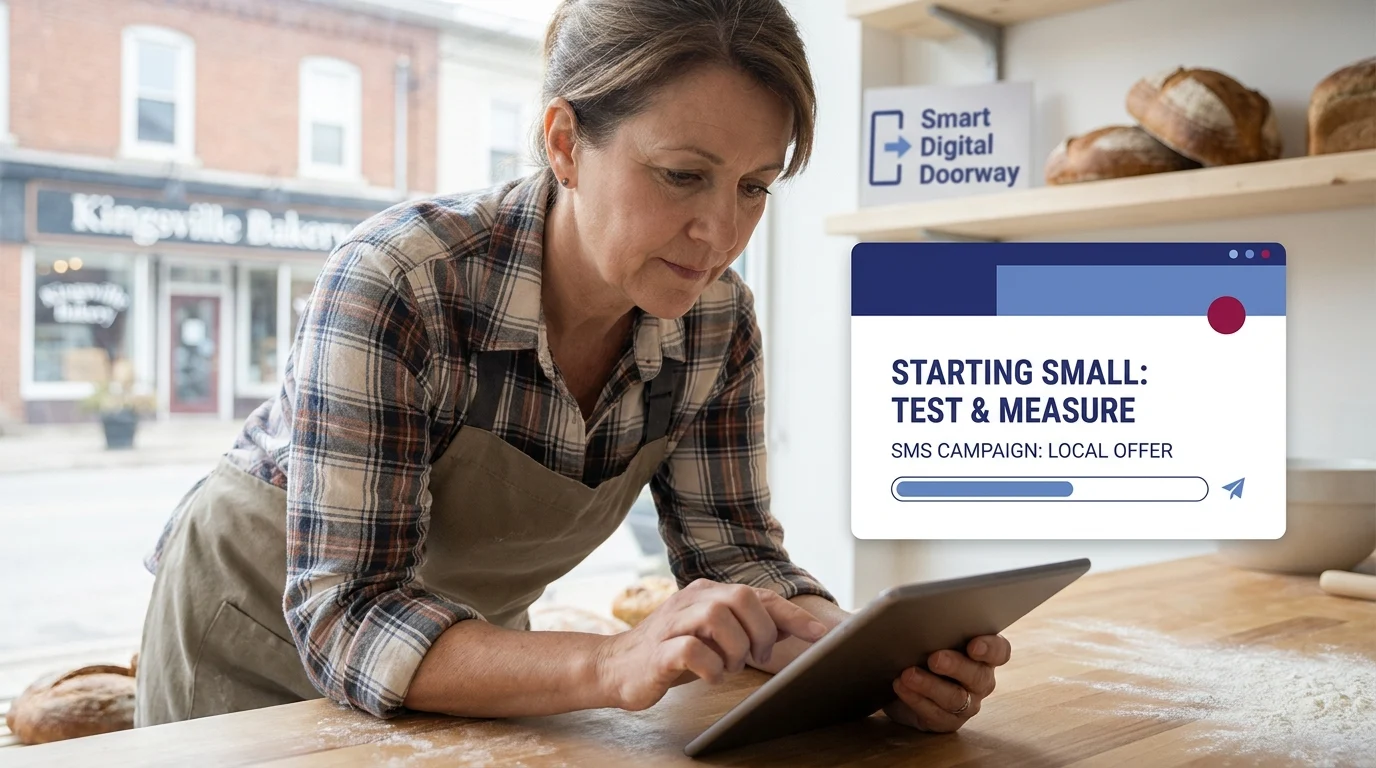
You don’t need a six-month plan or a big budget to find out whether SMS marketing for small business actually pays off. A focused 90-day test, run on one segment of your list, will tell you more than any case study. Here is how to structure it so you spend a little, learn fast, and stay compliant.
Step 1: Build a Clean Opt-In Flow
Start with a single, clear entry point. A keyword sign-up (“Text JOIN to receive offers”) works well at the point of sale, on receipts, or on your website. Whatever the channel, the consent language must be explicit: state what subscribers will receive, roughly how often, and that message and data rates apply. Capture the date and source of every opt-in. If you ever face a compliance question, that record is your proof.
Step 2: Make Opt-Out Effortless
Every message should honour STOP, and your platform should process those requests automatically. Test this yourself before you launch by texting STOP to your own number and confirming you’re removed. A clean opt-out flow protects you legally and keeps your list made up of people who actually want to hear from you, which is the only kind of list worth having.
Step 3: Run One Campaign on One Segment
Resist the urge to blast everyone. Pick a single use case with a measurable goal: an appointment reminder sequence, a limited-time offer to past customers, or a restock alert. Send to a defined group of 100 to 300 subscribers so the numbers stay manageable and the results are easy to read.
Step 4: Track the Metrics That Matter
Vanity numbers like total sends tell you nothing. Watch these instead:
- Click-through rate on any links in the message
- Conversion rate, how many recipients booked, bought, or showed up
- Opt-out rate per send (anything above 2 to 3 percent signals a frequency or relevance problem)
- Revenue per message sent, compared against your per-message cost
Revenue per message versus cost is the figure that settles the question. If a campaign earns several dollars for every cent it costs to send, you have your answer. If opt-outs spike and conversions stay flat, you’ve learned that cheaply, on a small group, before scaling a mistake to your whole list.
Key Takeaways
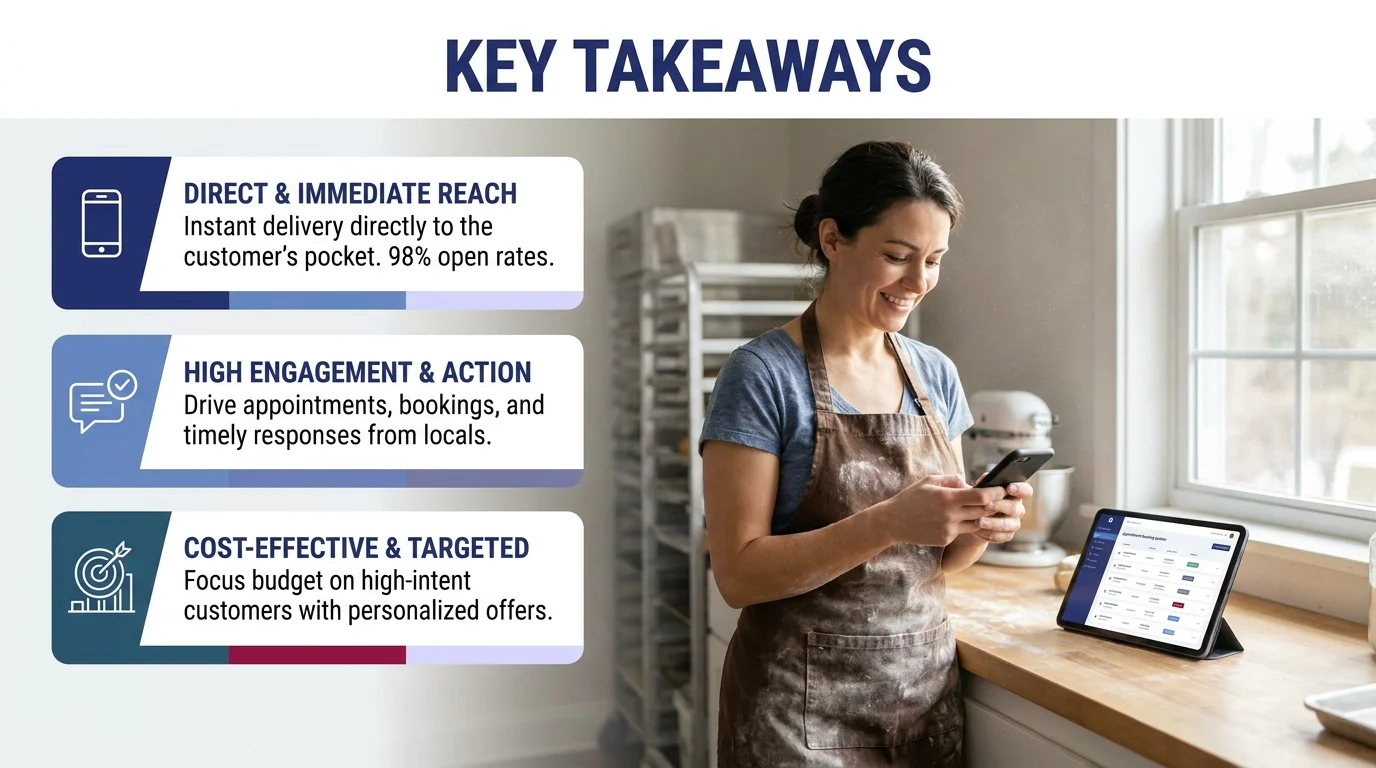
SMS marketing for small business is still worth it in 2026, but only when it’s run with discipline. The economics favour the channel: high open rates, low per-message costs, and immediate reach. The risks are real too, mostly around consent and over-messaging, and they’re entirely avoidable with clean opt-in records and an easy opt-out.
Treat your first campaign as an experiment. Start with one segment, one clear offer, and a short list of metrics that connect directly to revenue. Let the per-message return decide whether you expand. That approach keeps your downside small and your learning fast, which is exactly what a small business needs before committing to any new channel.
Doorways Into Your Business helps small and medium businesses in Kingsville, Ontario and the Windsor-Essex Region set up SMS and automation systems that capture leads, reduce no-shows, and follow up with past customers. If you’re losing customers after hours or struggling to follow up effectively, start with a free audit and we’ll show you where the quick wins are.
Paul Hughes founded Doorways Into Your Business after more than five decades consulting across 30+ countries, from implementing early IBM email systems in the 1980s to running multi-million-dollar IT projects for global organizations. A St. Clair College graduate (1976), he settled in Kingsville, Ontario in 2019 to help local small businesses grow with practical “smart digital doorways”, websites, customer service, reviews, bookings, and payments, matched to what a business needs, not unnecessary technology.
All articles by Paul →